The Studeblogger

Sunday, September 15, 2013

Differential Dilemma.

A persistent small drip from Barney's rear end finally led me to get under the car and inspect the cause. It turned out to be the fact that most of the differential cover bolts had vibrated loose. Obviously, they needed tightening.

As Barney's 1,000-mile chassis lube was coming up (Studes need chassis lubrication every 1k - not like today's 10,000-mile wonders!), I decided I'd do both on the same day, and picked out a nice Saturday to get 'er done.


The first task was to get his butt up in the air. As there are no front parking brakes, it's necessary to lift both front and rear in order to be safe. Note that there are chocks on both sides of the rear tires, as well as jack stands at the rear and front chassis fishplates. You can't be too safe, no matter what car you're working on! Use proper jack stands in good condition and make sure that, when you're rolling around under there, you don't use the chassis as leverage to move - it doesn't take much to pull the car off the stands and down onto you. This generally goes poorly for the human component.


The reason you want to lift the rear end for this is that you're going to need some elbow room. When the car's suspension is fully compressed, the upper differential cover bolts are difficult to access, since they're hidden behind the forward edge of the fuel tank. With the rear end fully lifted, you can easily get to all the cover bolts.

Getting out the trusty Studebaker Shop Manual, I found that there is a torque spec listed for the cover bolts (as there is on nearly everything!). Barney's axle is a Dana 44 limited-slip differential (known to Stude lovers as a Twin-Traction axle - PosiTraction if you're a Chevy fan), so the torque spec is listed as 25 - 30 foot-pounds. Don't use this spec if you have a Dana 27 rear end; the torque required is much lower.

In fact, I learned something important: you may not want to use any torque spec for this operation. But more on that later.

Anyway, I got out my big 1/2"-drive Craftsman DigiTork and proceeded to tighten up the cover bolts. And they were loose. Some at the top were very nearly finger-tight. No wonder it was dripping! So, working my way around, I tightened up each bolt. And, of course, on the very last bolt, something went wrong. The bolt wouldn't torque up, and...well, you know what happened next.


Yep. Off twisted the bolt-head and into the pan it dropped. And the leak, which had previously declined as the cover was tightened, suddenly turned into a significant dribble.

As the sweat started forming on my forehead, I remembered that I had a set of quality bolt extractors. I was going to have to drill out that booger.


This is a tool everyone should have in their box, because sooner or later, you will bust off a bolt. These are reverse-extractors: first the chisel-tip drills the center out of the broken fastener, and then the threaded collar bites into the drill-hole and backs the fastener out of its place.


By the way, be safe: wear goggles when you do this work. Flying steel chips and eyeballs are not a great combination, ya dig?


So I went to work, beginning to drill out the broken bolt, when - wonder of wonders! - something awesome happened. The bolt head had broken off in such a way that it left a nearly straight ridge of metal left across the face of the shaft. When I began to drill, the extractor caught that ridge and the broken shaft backed out of the axle housing like a hot knife goes through butter - no drilling needed. Thank you, God!


As you can see from the pic above, the bolt stretched. You can actually see the deformation of the threads. This failure mode is really what saved my bacon. As Bob Palma (the SDC Technical Editor) noted in this thread on the Studebaker Drivers Club Forum, had it bottomed and been impacted, removal would have been a ton tougher.

Here's where the learning comes in. Even though there's a torque spec in the shop manual, Bob recommends not using it. An automotive professional for over 40 years, Bob says:
I don't even torque mine; I just use a step-down reducer from 3/8 to 1/4 inch drive and then tighten them about as tight as I can get them with a 1/4" drive ratchet, which, as you know, is pretty small. That doesn't squeeze out the gasket, as do higher torques.
 And that's just what I'll do next time.


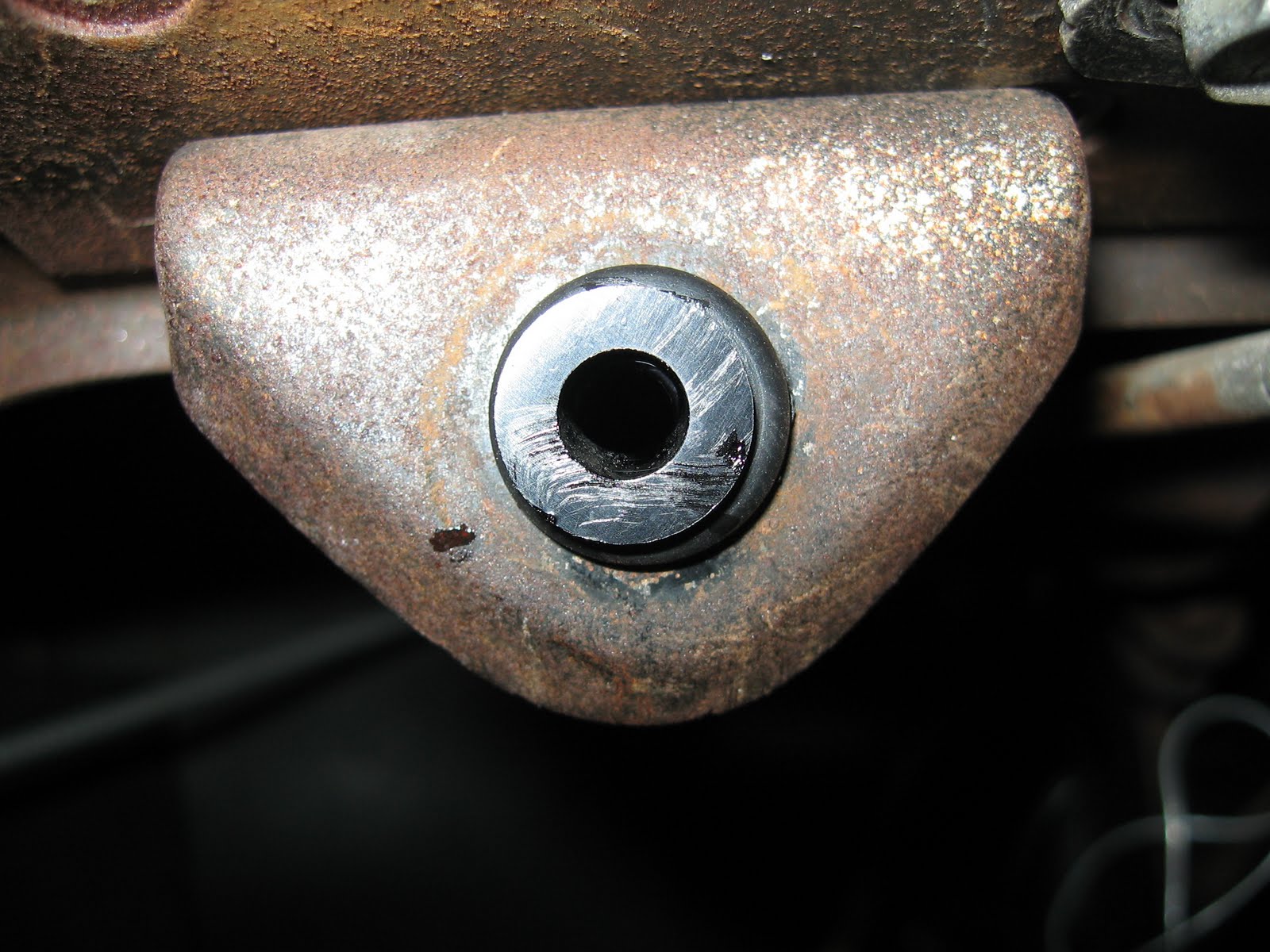
I had a new bolt of the proper size in my bin, so I screwed it in and the leak stopped, but now I'd need to refill the axle. Running a differential dry isn't good for you, for your car, or for your wallet! So down went the car, under went the catch basin, and out came the gear lube. Why lower the car, when having it up would have made filling easier? Because you fill the axle with lube even with the bottom of the fill hole, so the car must be level when you do it.

Removing the filler plug will require a Crescent wrench; a 12" should do.


Just so happens I was prepared, with a brand-new bottle of gear lube in the garage. Now, some guys stick a clear vinyl tube on the bottle spout and stick it in the hole to fill the axle; others have used their wives' turkey baster (not a recommended procedure!). I prefer to add a little at a time, so as not to overfill and have a river of lube pouring into the pan. I used a spare medical syringe available at any pharmacy.


As it turns out, the axle was pretty empty. It took about 20 of these - I estimate between 1.5 and 2 cups of gear lube went in before the proper level was reached.


See the differential gear carrier, visible inside the case through the hole? Besides the tags on the axle housing, this is one way to physically confirm that the axle is a real Twin-Traction limited-slip diff - the carrier is so large that an index finger inserted in the hole will be stopped by the carrier at the first knuckle. If the differential was a standard "open" unit, you'd be able to get an entire finger in there.


In this photo, you can see a little trickle of lube out of the hole. That means it's filled to the proper level. After it's filled, all that remains is to wipe the case and reinstall the filler plug. Remember, you're going into a steel cover with a cast-iron plug - so clean the threads and tighten it up snug, but not so tight that you strip it out.


All back together - and just in time for International Drive Your Studebaker Day on September 14th! All's well that ends well. And all's well that doesn't leak, too.

Labels: , , ,

Saturday, March 09, 2013

Advanced Distributing for Studebakers.

That little part above is, as you probably know, a vacuum advance canister (or "spark modifier" in Studebaker parlance" for a Delco distributor of the type used on Studebaker V8 Larks from 1960 to 1961. Although only used by the factory during those two years, the "window-type" Delco is prized by many Stude drivers because it's easy to rebuild, get parts for, and set point gap on, compared to the Prestolite units used on other years.

As detailed in an earlier post, I obtained and rebuilt one of these Delcos, using a core graciously given to me by Warren Webb, one of the regulars on the Studebaker Drivers Club Forum.

At the time I built it, however, I installed a vacuum advance specified for a 1961 Impala, figuring (wrongly) that a vacuum can is just a vacuum can. I should have known better! What I've found out since is that not all cans are equal. On this Forum thread, Joe Hall notes that the can commonly sold for Studebaker applications (NAPA VC680) is actually 2 degrees shy of the Studebaker OEM advance setting for V8 cars.

It turns out that nearly all of these vacuum advance units are all manufactured by Dana Engine Controls, now owned by Standard Motor Products, so no matter what brand you buy, it's the same part in the box. The trick is determining the right part. And there are about 25 different cans, each with a different setting for the point at which full advance kicks in. So how do you identify them?

Dana stamps a number on the mounting bracket of each advance unit. Each number corresponds to an advance profile that denotes how much vacuum must be applied to achieve full advance. It turns out, according to Joe Hall's research, that the Studebaker part number is "B20." The VC680 that NAPA's system specfies is "B1". Obviously the wrong part.

Insufficient advance can be responsible for lost power and poor gas mileage - both of which my Barney has exhibited. So I started digging to find out what part number was correct for the Studebaker distributor. VC1765 turns out to be the correct Stude part.

Thanks to the guys on the Corvette forums, who know their stuff when it comes to Delco parts, I found out the difference in the two parts' advance delivery settings:
  • VC680 (stamped "B1") delivers 0 degrees of advance until 8" of vacuum, and 16 degrees of advance at 16" of vacuum.
  • VC1765 (stamped "B20") deliver 0 degrees of advance until 6" of vacuum, and 16 of advance at 12" of vacuum.
So the part I had on the car started delivering advance too late, and full advance came in waaaaay too late. No wonder I was getting crappy mileage! B20, by the way, is the unit used on high-performance GM engines. I take a bit of pride in knowing that. (According to a very scholarly treatise on vacuum advances written by Lars Grimsrud of TunedbyLars.com, B26 carries the same specs as B20 and may be found in the same box.)

So I went to my friendly local NAPA and ordered a VC1765. Wisely, I  checked the part before leaving the store - the wrong part was in the box, with a hand-written label that had another part number on it! Always check. Another part ordered, and this time it was correct - B20 stamped into the boss.

Replacement is easy, and doesn't require removing the distributor from the car. Just unplug the coil wire and undo the two spring-loaded screw clamps that hold the distributor cap on, and move it out of the way. The screws that hold the vacuum advance to the distributor base are accessible from the passenger side of the car once the cap is removed.

As you can see in the photo above, there are two screws holding the advance unit on. Use a magnetized screwdriver to remove them, otherwise you'll be cussing as you remove the distributor to fish them out after you've dropped them! Also note that a lug attached to a wire that grounds the breaker plate is located under the screw at the end of the actuating rod - you'll need to replace it there after installing the new advance.

After the screws are removed, pull the advance unit out; the actuating rod will then be able to rotate out of the hole in the breaker plate by pulling the advance body upward.

Installation, as they say, is the reverse of removal. Once it's all back together, don't forget to check the timing and reset the idle if need be.

For some interesting reading about vacuum advance, check out this post from the Vetteclub Forum, and the aforementioned paper from Lars Grimsrud. You'll find out everything you need to know and more!

Labels: , , , ,

Sunday, January 27, 2013

Installing a Studebaker Windshield


Up in Washington state, my friend Dick Steinkamp is restoring a very nice '63 Wagonaire. As part of the restoration, Dick needed to install a new windshield. There's an art to doing this, especially in an older vehicle like our Studes. Dick got an installer out to his place, and photo-logged the entire process. Check it out here.

Even if you don't plan on doing this yourself, this is a valuable lesson in how the job is done!

Labels: , ,

Thursday, January 17, 2013

Studebaker Front End Rebuild Series

 
One of the most popular topics on my blog has to be the How-To series I wrote about rebuilding your Studebaker's front-end suspension. This is the topic of more questions than any other, and get more hits than any other here on the site, too. So here's a listing of all eight parts, now in one convenient carry-home size!

Now go get'er done!

Labels: , , , ,

Friday, September 07, 2012

Fiberglas Hawk Panels!

We've all run across 'em - a car so beat, so decomposed, that even the thought of attempting metalwork on it gives you the cold sweats and causes your wallet to ball up in a paroxysm of self-preservation. But still, you want the car... you have a vision.

For those of you with a Studebaker Hawk in that viewport, there's some good news: you may find steel body panels scarce, especially for the later, lower-production GT models, but there's a company out there producing Fiberglas bolt-on fenders, doors and trunk lids for these rara avii. Meet Class Glass Performance, of Cumberland, Maryland.


These guys have been around since 1990, making Fiberglas parts for street and track racers. The Hawk's slippery profile has long been a favorite of drag racers, so 'glass body parts are a natural. They make everything from complete body tubs (shown above) to individual doors, trunk lids and front clips for '53-62 Studebaker C/K bodies. So when you find a car that looks like this:


...you can start thinking about bolt-on replacements instead of getting out the torch and spoon.They also make sweet fender replacements for Studebaker M- and R-series trucks!


Labels: , , ,

Sunday, August 26, 2012

Steering Wheel Repair for the Home Studebaker Enthusiast

If you're working on an old car, you're likely at one time or another to come up against a steering wheel from hell. One that looks like the bad boy above (this particular vision in plastic was looted from from a '61 Studebaker Lark 4-door. The rest of the car looked worse).

So what do you do with a beast like this? Paint is easy enough, but what about the cracks? Several companies make kits to restore steering wheels (like this one from Eastwood), and some companies will re-cast your wheel -- they break off all the old plastic and mold new plastic onto the wire frame. Schrock Brothers are one such company well-known in the Studebaker world.

But most of us don't need a re-cast wheel and are willing to take on the process ourselves. But even though the kits you can buy are well-documented with detailed instructions, there's a bit of trepidation involved in breaking out the tools and cutting into your wheel, no matter how unlovely it is.

Tool Dude Tony, also known as Dudorino on the SDC Forum, has posted a YouTube video showing just how easy it is to do this job yourself; he illustrates on the wheel from his own '57 Hawk (seen in the vid). All you need are a few common tools, some two-part epoxy, and a little time, and you can have that wheel back in presentable shape in no time.


It's been noted in this Forum thread that the POR epoxy that Tony uses in the vid is suitable only for hard plastic wheels, as it cures rock-solid. If you have one of the flexible wheels, 3M #8081 Panel Adhesive is recommended as a filler, as it solidifies but does not harden.

Now there's no excuse for that lousy cracked wheel! Git 'er done!

Labels: , ,

Monday, February 20, 2012

Lark Deodorant: or, how to get rid of that fuel smell

If you own an old car, it's virtually guaranteed that you will spend time, effort and money trying to track down some problem that should be easy to fix, but which somehow eludes you in the same way in which common sense eludes politicians. This is the story of one such quest - now solved!

Almost since the first day I've owned Barney, there's been the smell of gasoline in the passenger compartment. I don't mean a little whiff - I mean "Hello sir, can I fill 'er up?"-level odor. It was bad enough to require driving with the windows open and vent wings, too, in order to keep the air clear. In chasing this problem, I'd been systematic - replacing the two soft sections of fuel line between the tank and carb, replacing every gasket, hose and tube between the filler neck and the tank inlet (see this post for details), and checking the seal for the fuel gauge sending level for leaks. Nothing worked... it smelled as strong as ever.

Finally, I got a break. I was browsing through Barney's Chassis Parts Manual last weekend (yeah, I read parts manuals for relaxation... ya wanna make something of it?), and noticed something I'd never seen before in the parts diagram for the '62-'63 fuel tank: a UFO (Unidentified Fixable Object).

Look at the diagram above. See the long, bendy tube coming off the filler neck and running to the left? That's the fuel tank vent tube. Studebaker used an non-venting gas cap on later Larks, so this tube was used as a fuel tank vent. It clips to the rear valence panel inside the trunk, wraps around the left taillight assembly, and finally exits through the trunk floor. Well, see the itty bitty part circled in red on the diagram? That's a grommet. It's purpose is to go on the end of the vent tube and seal its exit through the floor pan.

I had never, ever seen this part callout before! And of course, the original one was long gone, so there was no visual evidence that anything was supposed to be there when I inspected the trunk.

So I went down to my local Ace hardware and got an appropriate-sized grommet from the bins (1/4" I.D., 3/8" O.D.), slid it over the end of the vent tube and pressed it into place in the floor.


Woo hoo! That did the job. After a week, I went out and opened up the car at noon - typically when the smell was strongest, after having sat for a while in the sun. No smell! I drove the car around for about 2 hours that afternoon, just to make sure, and the problem is gone.

So, big thanks to a .45-cent part for making my car pleasant to drive again :)

While I was at it, I fixed one more fuel-related problem. A few weeks back, I moved the car onto the street and parked it nose-up (I live on a pretty steep hill). When I came back, a wet spot under the back bumper and a slow, steady drip told the tale: the fuel cap seal was about as loose as a sailor on Friday night.

The factory fuel cap uses a partial-face seal. In the photo at right, you can see it just around the center stamping - that dark brown circle. This is a fiber gasket attached to a steel backing ring; it's only as big as the end of the fuel filler itself and seals to the rolled edge of the filler pipe. I guess that after 49 years, this seal has gotten a bit softer than it was, originally.

The fix for this is actually pretty easy: just add more gasket material. I went down to my neighborhood NAPA and got a roll of 3/32 Fel-Pro cork gasket material. I used aluminum foil to trace the size the gasket needed to be, then cut a circle out of the cork and slipped it around the center of the cap.


Now the cap fits nice and snug, and there's no way any gas is getting past that seal. It ought to help with my fuel economy, too, since the gas formerly used to lubricate the asphalt will now be going into the carb!

Labels: , ,

Sunday, June 19, 2011

Transmission & Engine mount replacement technique

While searching out some transmission information on the SDC Forum, I came across this great bit of advice from one of the Forum stalwarts, Gord Richmond, on how best to replace Studebaker engine and transmission mounts, something that will eventually need to be done on every Stude. Even low-mileage cars can require replacement of these parts, as age and oil will break down rubber, causing mounts to sag or shear. This condition can be downright dangerous, as an out-of-position drivetrain can cause critical linkages to bind at the worst possible times, possibly leading to loss of control and even runaway engine operation.

So, from Gord's post:

With the car securely supported on jackstands, remove the nuts from the lower studs on both tranny mounts. Then "crack" the bolts holding the mount brackets to the bellhousing. Use a floor jack with a plywood pad to raise the tranny by carefully jacking under the pan. It'll only go up a bit less than 2 inches; don't force anything. With the tranny supported, back out the bolts holding the mounts to the bellhousing, and remove the old mounts. Real bad ones will come out in 2 pieces.

Note: when installing rear mounts, I suggest you install both together; drop the studs into the crossmember, installing the spacer where required, lower the tranny to slightly above its rest position, then start the capscrews that hold the mounts to the bellhousing, and get them in a few turns, then put nuts on the mount lower studs, and spin them on a few turns. The you can gradually lower the tranny the rest of the way, and tighten the fasteners as you go. Once the tranny weight is fully borne by the mounts, you can torque the bolts up good. The reason for this procedure is as follows: with the mounts bolted tight to the bellhousing, the lower studs project out and down at about a 45° angle. The span between their tips will exceed the span between the holes provided for them in the crossmember, and you will be stuck. By installing them in a "gradual" fashion, you get around the geometry bottleneck, and also ensure that the mounts aren't installed with some built-in stress that will hasten their failure.

With the rear mounts done, a similar procedure will work on the front mounts. Be careful not to jack the motor so high that the distributor get damaged by interfering with the firewall. Sometimes, I've had to cut a little excess length off the front mount studs to enable myself to winkle 'em in.


While you're down there (if you have an automatic transmission), don't forget to check for the presence of the dreaded transmission spacer on the driver's side mount, as detailed in this earlier post.

Happy Studebakering!

Labels: , ,

Saturday, June 11, 2011

Yeah, I'm still here :)

Lots of stuff going on around here, very little of it Stude-related - except for me driving the car all over North County! I really do love the Studebaker, and things are slowly getting dialed in. I got a new set of spark plugs from Chuck Collins Studebaker today (Champion H14Y, stock #91, if you're in need), since I plan on adjusting the valves tomorrow. Why does this require that I lay in new plugs? Well, the last time I removed plugs, I wound up cracking one off - so I figure, better safe than sorry!

I have gotten a couple of small (emphasis: small) projects done, though. One involved rehabbing the fresh-air intake on Barney. In '63, Larks got a new Climatizer system that placed the heater core and valve horizontally under the dashboard (instead of mounted vertically on the firewall as in years past). This made use of the Lark's cowl-mounted fresh air grille for heating and cooling. The heater core is mounted on the passenger's side of the car, with ductwork carrying fresh or heated air to the other side of the car. But on the driver's side of the car, there was a fresh-air vent under the dash that was just an updated version of the old fender-flap air scoops that the earlier models had; the difference was that the Lark's air flap also let in air from the cowl vent (rather than the fender).

In my car, the driver's vent wouldn't close. There's a latch, meant to hold the duct shut tightly when you don't want air forced in, and no matter how hard I pushed the knob in, I couldn't get that duct to shut and latch. Close examination revealed that the actuating rod was bent and misadjusted.


This photo shows the driver's vent from the perspective of the carpet, a position I've become accustomed to from all the changing of dash switches, rewiring, replacing of ignition switches, etc. The actuating rod in the foreground attaches to the vent door. See the little latch mechanism? See how the vent is not shut all the way? See the kink in the rod? Yup... that was my problem. The rod was so bent that it prevented the vent from being shut properly.


After removing the rod I hammered it straight using my bench vise. There! Much better! But hold on there - not so fast. There's a bracket on the dash that the rod rides in, and it's lined with a rubber grommet. Mine was rather perished - old, dry and cracked. May as well not have had a grommet there at all.


Determined to fix this, I pried out the rubber (came out in 3 pieces, natch) and headed down to my local Tru-Value, who often have oddball parts that fit my Stude. But not this time, and the Studebaker International catalog showed no stock for this bit, either. What to do, especially now that I'd crumbled my old piece into fine black bits?

Tru-Value and Yankee ingenuity to the rescue. If I couldn't find the right size, I'd fabricate a suitable replacement! Heading to the hardware store, I grabbed a rubber grommet with a suitable outside diameter, and a pair of Delrin shoulders that press-fit into each other, and assembled them into a Delrin-lined grommet that would fit into the bracket.
The bits, unassembled.

 The Delrin/rubber sandwich.

The installed bushing.

Success! It may not be original, but it works great - quiet, no rattles, easy slide. After reinstalling the actuating rod, I found that the vent door still wouldn't latch all the way, but that the bracket itself could be loosened and slid backward - which I did, and now feel the door close with a satisfying *snick* when I push the knob all the way forward.

Adjusting screws.

Success!

I smeared some white lithium grease on the latch after polishing the rust off it with some 200-grit paper, and it works smoothly and quietly.

Oh, and that rubber seal around the vent flap? It turned out I didn't need one but I ordered it anyway from Studebaker International - part # 1338907.


Labels: , ,

Friday, February 04, 2011

A really good Stude week! New springs and more.

It's really been a great couple of weeks, Studebaker-wise. I've gotten a lot of little (and not so little!) things done, all of which added up to a lot of things that make the car more livable.

First, last weekend, I fixed the leaky fuel filler hose that had been venting fumes into the passenger compartment from the trunk. I also got the new ignition switch into the dash, replacing the old one with the weak return spring and bad accessory contacts, and put in a brand-new headlight switch that doesn't leak smoke and melt connectors - so now the headlights work properly. The new relay turn-signal indicator finally works the blinkers loudly and regularly.


If you've been following my blog for a while, you might notice a difference in Barney while looking at the photo above. That's right - I finally got the rear springs installed.


The smiling man above is Tony Elkins, owner of North County Spring in Escondido, California. Tony is the ultimate California surfer dude, blonde hair, beach accent, easy-going good nature and all. Tony used to run E&C Spring, the shop that his dad owned for over 30 years. About 5 years ago, Tony's dad died, and a family rift developed about how the business should be run. Tony was on the side that wanted to run an honest shop, so he left to start his own. Let me say that there is no one in this county that I would trust more to do the job than Tony and his crew. Need springs? They repair, replace, rebuilt, re-arch - they even bend their own U-bolts. While you wait. I recommend them highly:

North County Spring
446  Enterprise St.
Escondido, CA. 92029
760-738-7020

Luckily, I was able to secure a set of brand-new OEM springs from SASCO before they went out of business and their inventory transferred to Studebaker International. I got these factory springs at a ridiculously low price - Eaton Detroit wants $400 a pair plus shipping; I secured these factory NOS parts for a quarter of that.


They did have 40 years of warehouse rust on them, though, so my son stripped them and I painted them and they were ready to install.

The problem, however, lies in removing and replacing the spring bushings that are pressed into the car's frame itself. Much has been written on the SDC Forum regarding the process of replacing these bushings, with instructions on how to fabricate a tool to pull the old ones out and slide the new ones in. But those steel-shelled bushings have been in the frame for 40+ years; they're not coming out easily. Tony originally thought it would take 4 hours of shop time to R&R the springs... that turned into nearly 10 hours which included having to torch out the old bushing shells, necessitating removal of the fuel tank as well... yeah.

They also replaced the rubber hose that connects the gas tank to the fuel pipe. It was so old and brittle it literally crumbled in my hand when Tony showed me the old bits. Like a dry biscuit. Glad that one got fixed before it came apart on its own.


But oh, what a difference those new springs make! The top photo above shows the rear wheel prior to spring replacement. You can see that the tire is partially within the wheelwell; the tread is well above the lip of the fender. In the lower photo, you can easily see the different the new springs make - the top of the tire is plainly visible now within the fender. There's at least 3 - 4" difference in rear-end  height.

Here are some before-and-after shots of the entire car, and you can see the difference in the stance of the car. The top shot is before, the bottom after:


Where the difference really shines is in the driving, though. The car handles much better without the rear end wiggling all over the place; I don't have to slow down to 10 MPH around corners just for fear of the car falling off its suspension. It tracks truer as well - goes where I point it. Chuckholes that threatened to break the rear end loose and send it sideways are now nothing more than a minor annoyance.

Finally, an order from SI arrived yesterday, with some long-awaited goodies inside: a reproduction Strato-Line mirror for the right side of the car, and a set of new rear seat belts to replace the scuzzy MoPar belts that the PO installed.


I took Barney out for an after-dark drive tonight. Lights on bright, gauges all indicating a happy engine. Heater pumping out welcome warmth, while the 259 burbled through the dual pipes. The car's really starting to be fun to drive now. I've loved this Stude for a while - now I'm beginning to really like it, too.

Labels: , , ,